Easter Flower Arranging for Church and Home, A Guide
Easter Flower Arranging
Easter flower arranging is the practice of building a small arrangement from 3 to 5 cut stems, gathered into a 15 centimetre (6 inch) vase, and set on a church table or a home dining table so it is ready for Easter Sunday service.
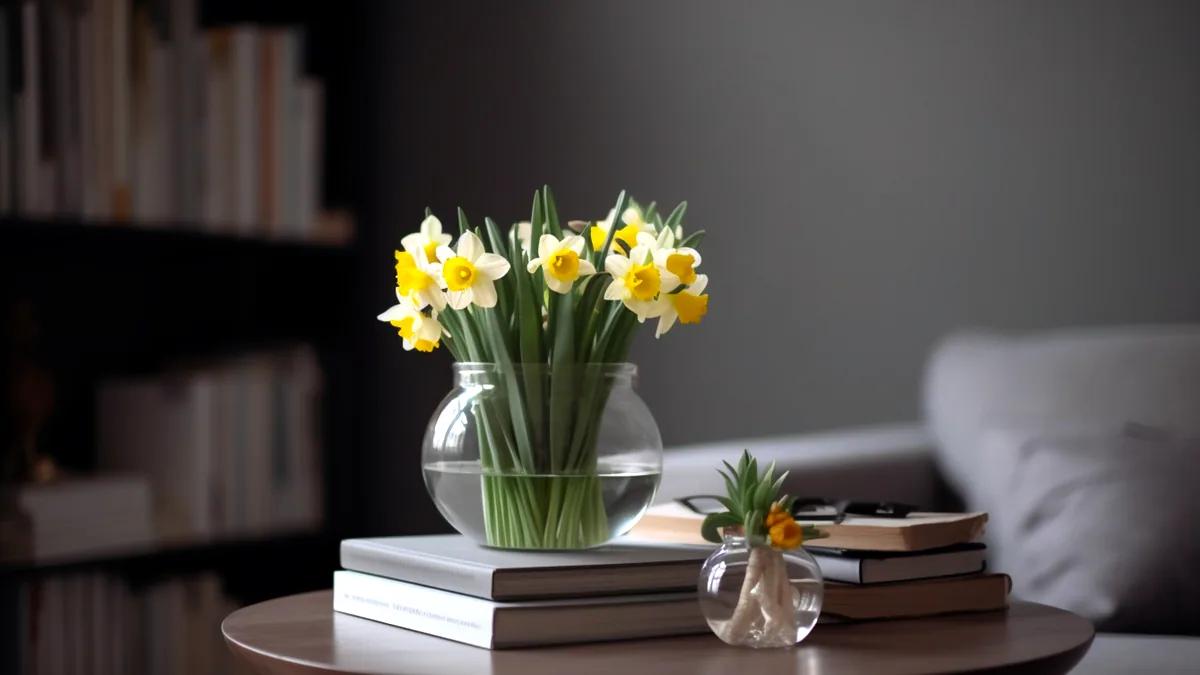
It is a hands-on task a person of any age can complete in 30 minutes with a bucket of water, a sharp knife, and a handful of spring stems. The aim is a calm, bright arrangement that reads well from a distance, sits level with the eye, and holds for 3 to 4 days across the Sunday service and the meal that follows.
Before you gather anything, it helps to know what the finished thing will look like, because that one picture guides every cut you make. For church you want a low, round mound of blooms about 15 centimetres tall, wide enough to be seen from three rows back. For home you want a taller, looser arrangement of 20 centimetres that fills a dining table without blocking a conversation. A Flower Arranging for Seniors session is built around exactly this: the same low church shape, the same three stems of spring colour, and the same 30 minute window, taught slowly so a first timer can follow each step. You do not need a studio or expensive equipment; a kitchen table, a 6 inch vase, and a few stems are the whole kit.
What an Easter arrangement looks like
An Easter arrangement is defined by three visible things: a low height, a round footprint, and a soft spring palette. The height keeps it from crowding a table, the round shape keeps it readable from every seat, and the palette keeps it calm on a busy Sunday. Most arrangements built for this job use 12 to 15 stems in total, which is enough to fill the space without a wall of flowers. The classic palette pairs 5 white or pale yellow blooms with 3 to 4 stems of greenery and a small accent of a deeper colour, so the arrangement glows but stays quiet. White tulips, freesia, and a few sprigs of eucalyptus are the usual starting point, and they are cheap enough to replace if the first attempt is not right. This same low, round shape is the one you would meet in a A Flower Arranging Class for Seniors, where the teacher starts with a plain vase and builds the mound one stem at a time so every learner sees how the form grows.
Choosing flowers for Easter Sunday
To choose flowers for Easter Sunday, pick stems that are already in season, because seasonal spring blooms are cheaper, fresher, and last longer than anything forced or imported. A reliable list for a UK Easter includes tulips, freesia, ranunculus, and a soft green such as eucalyptus or ivy. Each of these carries a role, and the roles are the whole logic of the arrangement. Tulips give the height and the gentle nod at the top, freesia gives the fragrance and the fine texture, ranunculus gives the rounded body of the mound, and the greenery gives the shape that holds everything together. If you are setting up a church, where a single arrangement must be seen from a distance, lean on the ranunculus for its solid round blooms. If you are setting up a home table, where people sit close and lean in, lean on the freesia for its scent. Either way, buy one extra stem of each type, because a fresh stem is easier to remove than a missing one to add back later.
Gathering the materials you need
To gather the materials you need, keep the list short and check each item before you start, because a missing 15 centimetre vase or a blunt knife turns a 30 minute task into an hour of frustration. The full kit for one arrangement fits in one small tray.
| Item | Size or count | Why it matters |
|---|---|---|
| Spring stems | 12 to 15 total | Enough to build a full mound |
| Vase | 15 centimetre (6 inch) glass | Low height for a church or table |
| Fresh water | 1 litre in the vase | Holds the stems upright |
| Sharp knife or scissors | 1 | A clean angled cut drinks better |
| Floral tape or wire | 1 short piece | Grips loose stems in the vase mouth |
| Flower food | 1 sachet | Extends life from 2 to 4 days |
Each of these plays a part in how long the arrangement survives, which is the next thing to plan for.
Step by step, building the arrangement
To build the arrangement step by step, follow the order below, because each step depends on the one before it and skipping ahead leaves gaps you will have to fill in. The whole sequence takes 30 minutes once the water is ready.
- Fill the 15 centimetre vase with 1 litre of fresh water and drop in 1 sachet of flower food, then stir until it dissolves.
- Trim 12 to 15 stems at an angle with a sharp knife, cutting 2.5 centimetres (1 inch) off each base.
- Strip any leaves that would sit below the water line, so the water stays clean for 3 to 4 days.
- Start the mound with 3 stems of the tallest bloom, set them 5 centimetres apart, and hold them in the vase mouth with floral tape or wire.
- Add the ranunculus and freesia around the outside until the round shape is full, keeping the top no higher than 15 centimetres.
- Push in the greenery last, working it behind the blooms to close any gaps and hold the stems in place.
- Step back, turn the vase a full circle, and adjust any one stem that stands out before you set it down.
Finish each arrangement on a flat, level surface, and this same order is the one that a A Flower Arranging Class for Seniors walks through slowly, stem by stem, so a first timer can keep pace and end with a finished shape on the table in front of them.
Setting it out in church or at home
To set an arrangement out in church or at home, match the height to the place, because a 15 centimetre arrangement that works on a home dining table will vanish on a church table and a 20 centimetre arrangement that works at home will block a view down the nave. For church, sit the vase on a solid table at least 40 centimetres high so the blooms rise to the eye of someone three rows back. For home, keep the arrangement toward the centre of the table but leave 30 centimetres of clear space on each side for plates and for a hand to reach across. In both places, water the stems once on the day of the service and once on the day after, which is the single habit that pushes the life from 2 days to the full 4 days. The arrangement should look finished an hour before the service begins, not in the middle of it, so a small water top up and a final turn of the vase are the last two moves.
Keeping it fresh through the day
To keep the arrangement fresh through the day, change what it drinks and keep it out of direct heat, because a cut stem loses water twice as fast in a warm room as it does in a cool one. The two moves that matter most are a fresh 1 litre of water with a new 1 sachet of food on the morning of the service, and a spot away from a radiator or a bright window. White tulips in particular open up as the day goes on, so an arrangement that looks modest at 8 in the morning will be full and bright by the afternoon, which is exactly what you want when a congregation or a family gathers. If a stem wilts, pull it out, recut 2.5 centimetres, and push it back in, and it will usually recover within a few hours. These small fixes are the whole of keeping it alive, and they are the same two moves you will see in a Christmas Flower Arrangements session later in the year, where the same low mound and the same 1 litre of water carry a different palette of red and green. The skill does not change between the seasons; only the colours do.
Why the activity works for older hands
Flower arranging works for older hands because the whole task fits a 30 minute sitting, uses light grip strength, and rewards a person with something they can hold and see at the end. Each of the steps is short and repeatable: trim, strip, place, adjust. A person can stop after 3 stems and still have a beginning, or push through all 12 to finish the mound, so the task scales to whatever energy the day holds. The colour and the scent give immediate feedback, and the finished arrangement gives a concrete thing to carry to a table. That is the point of the activity, and it is the same reason a person who has never done it before will pick it up again, and the same reason a person who once loved it will happily do it one more time. Making it is the easy part, and this is the one where a person can Make something for Easter that will sit on the table and be part of the day, not just something they watched happen. The arrangement lasts 3 to 4 days, long enough to be a small, bright companion through the service and the meal and the quiet afternoon that follows.