Christmas Flower Arrangements You Can Make Yourself
Christmas Flower Arrangements
A Christmas flower arrangement is a small, self-contained design built from seasonal blooms and evergreen foliage, and the finished piece takes between 30 and 45 minutes to make once the materials are on the table.
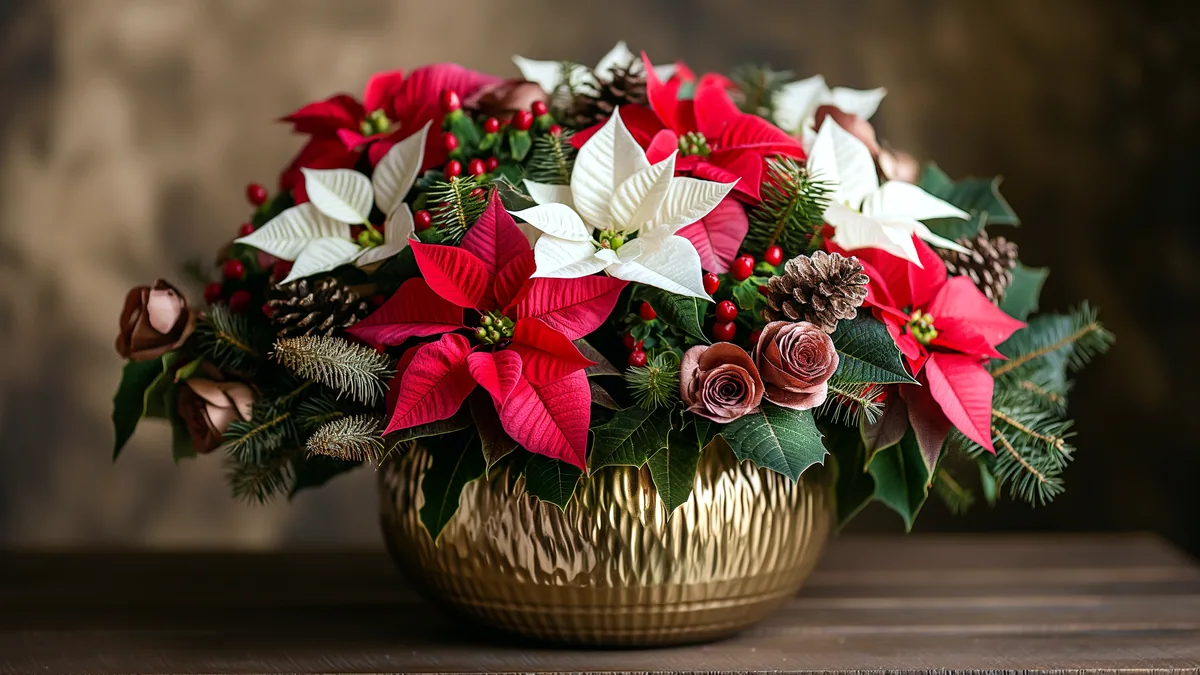
The 3 forms that work best for the season are the wreath, the centrepiece and the winter bowl, each of which uses the same 5 core materials: a base of pine, spruce or fir, a handful of berry stems, a few white or cream blooms, a ribbon and a simple fastener. Because the build follows one repeating pattern of gather, trim, layer and finish, a person who has never arranged flowers can complete a full piece on the first try, and the same pattern carries across every size from a 12 inch wreath to a tabletop bowl.
How to Choose a Christmas Flower Arrangement
To choose a Christmas flower arrangement, match the piece to the surface it will sit on and the number of people who will look at it, then pick the form that fits that space. The table below gives the 3 main forms, the size of each, and the spot where it reads best, so the decision is made before any flowers are bought.
| Form | Typical size | Best placement | Build time |
|---|---|---|---|
| Wreath | 12 to 18 inch diameter | Front door, hallway wall, mantel | 40 to 60 minutes |
| Centrepiece | 8 to 10 inch wide, low profile | Dining table, entryway table, console | 25 to 35 minutes |
| Winter bowl | 10 to 14 inch across the rim | Kitchen table, side table, coffee table | 20 to 30 minutes |
The wreath suits the largest and most public spot, the centrepiece suits a shared table where 4 to 6 people sit around it, and the winter bowl suits a smaller surface where a single person or a couple can reach it. If the spot is outdoors, choose the winter bowl in a ceramic or glazed pot rather than a wreath, because a bowl keeps its water and its form through wind and a drop in temperature.
What Materials You Need for a Christmas Flower Arrangement
The materials for a Christmas flower arrangement come from a short fixed list, and the 5 items below are the only ones required for all 3 forms. Buying the list once covers the wreath, the centrepiece and the bowl, so a single shopping trip supplies the whole season.
- Gather 1 to 2 bunches of evergreen stems such as pine, spruce, fir or boxwood, with the total length reaching about 40 inches for a wreath and about 20 inches for a bowl.
- Gather 2 to 4 stems of red berry, such as holly, hawthorn or hypericum, and keep the berries on the stem rather than picking them off.
- Choose 5 to 8 white or cream blooms such as winter rose, amaryllis, ranunculus or a single anemone for the centrepiece.
- Roll out 3 feet of ribbon in a matte red, deep green or gold, wide enough to sit at 1 to 1.5 inch across the band.
- Set out the fasteners: 24 gauge floral wire, a roll of floral tape, and a wire wreath form or a shallow bowl as the base.
The evergreens do the structural work, the berries add the 2 to 3 points of bright red that carry the colour of the season, and the blooms add the soft, rounded mass that reads as a flower arrangement rather than a bunch of foliage. This is the same 5-item list that a Flower Arranging for Seniors project uses, since the fixed list keeps the task inside a small, repeatable set of steps that a first-time maker can follow without guessing.
Step by Step for Building a Christmas Flower Arrangement
To build a Christmas flower arrangement, follow these 6 steps in order, and each step takes about 5 to 8 minutes, so the full build lands inside the 30 to 45 minute window named at the start. The steps hold for the wreath, the centrepiece and the winter bowl, with only the base changing between them.
- Trim every evergreen stem to a length of 6 to 8 inches and strip the lower 2 inches of each so the cut ends are clean.
- Twist the first 3 stems onto the base, crossing the wire around the form at 3 equal points, spacing them about 3 inches apart.
- Add the next layer of stems at a slight angle so each new stem overlaps the end of the last, working around until the base is fully covered.
- Push the 2 to 4 berry stems in at the points where the wire crosses, so the red berries sit at the top, the bottom and the two sides.
- Cluster the 5 to 8 blooms in the centre for a bowl or centrepiece, or at a single point for a wreath, tucking the stems into the wire and holding them with a short loop of floral tape.
- Tie the ribbon at the back of a wreath or around the rim of a bowl in a simple knot, leaving 2 tails about 6 inches long, then cut any loose wire flush with the form.
Each step ends in a visible, checkable state, so a maker can stop after any step and the piece still looks finished, which is the point of the layered build: the arrangement holds together at 6 inches of evergreen and is only improved, not repaired, as the steps continue. This same 6-step order is the backbone of A Flower Arranging Class for Seniors, where the fixed sequence lets a group of 4 to 8 people work at the same step together and finish at the same time.
The Sensory and Social Purpose of a Christmas Flower Arrangement
The purpose of a Christmas flower arrangement goes beyond the finished piece, because the making itself carries the sensory and social value that the page is built around. The task works on 3 channels at once, and each channel does a distinct part of the work.
- The scent channel: pine, fir and spruce release their resin as the stems are handled, so the room fills with the smell of the season while the maker works, and the scent stays in the piece for 7 to 10 days.
- The touch channel: cutting, twisting and tucking keeps both hands occupied with a fine motor task that takes about 5 minutes per step, which steadies the hands and gives a clear sense of progress.
- The social channel: the shared list and the shared steps let a group sit together at one table, each maker finishing their own piece, so the conversation follows the work rather than filling the silence.
These 3 channels are why a self-made piece outperforms a bought one for the people around it, and why the activity is worth scheduling on a weekday afternoon as well as on the day itself. The same sensory and social design is what makes the result a practical entry in any set of Gifts elderly people can make, since the gift is the object that was made by hand at a shared table rather than wrapped from a shop. For a quieter occasion, the identical build can be turned into a Flower Arrangements for a Funeral tribute by swapping the red berries for white lily of the valley and keeping the same evergreen base, so the skill learned here carries past the celebration and into the remembrance.
Where a Christmas Flower Arrangement Fits Across the Season
The Christmas flower arrangement does not stop at the 25th, because the evergreens and the berries stay fresh for 7 to 10 days and the structure holds until the 6th of January, when the season closes in the calendar. The same 3 forms move through the period in a fixed order, and the placement changes with each date rather than the design changing at all.
- From the 19th to the 24th the wreath sits at the front door and the centrepiece on the table, where the guests arrive and the family eats, so the piece is seen by the largest number of people first.
- On the 25th the winter bowl takes the main table and the wreath steps back to the mantel, so the day itself is centred on the bowl rather than the door.
- From the 26th to the 6th of January the bowl moves to an entryway table or a side table as a keepsake, and the same evergreen base can be reused for a hanukkah piece if the household keeps the 8 nights, since the structure is identical and only the ribbon and the 1 to 2 small blooms change.
Because the arrangement is built from a fixed 5-item list and a fixed 6-step order, it survives the season as a skill rather than a one-off object: the same build, re-run in January or for an engagement party or a graduation, reuses the identical materials and takes the same 30 to 45 minutes, so a person who makes one Christmas flower arrangement this year holds the complete method for every flower arrangement they will make for the year that follows.