Movement & Exercise for Older Adults: Start Here
Movement & Exercise for Older Adults
Exercises for elderly at home are a fixed set of movements you do in your own rooms, and the core kit has 5 items: a steady chair, 2 lightweight weights, a foam roller, a wall strap and a non-slip mat.
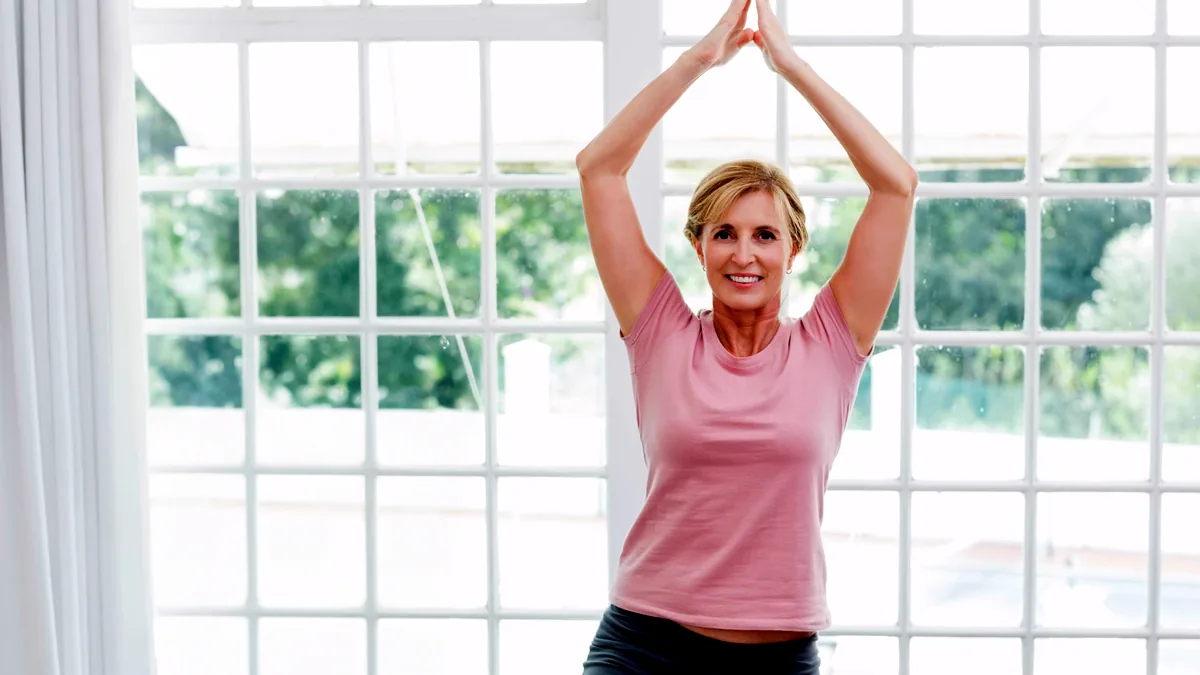
The purpose is 2-fold: it keeps the body moving through its daily range and keeps the mind supplied with a task, so the same 20 minute session protects the balance that prevents a fall and the routine that prevents a week of quiet days. You build the habit in 3 stages: you pick your 5 exercises, you run the session 3 times a week, and you add 1 new movement every 2 weeks.
The word exercise covers more ground than the word movement, and the difference is worth 2 minutes. A movement is any act that carries the body somewhere, such as rising from a sofa, reaching for a high shelf or carrying a bag from the kitchen to the table. An exercise is a movement done on purpose, with a count and a reason, and that is the difference the body notices over 12 weeks. The list on this page leans on the exercise side, because an exercise you can name, count and repeat is a thing a person can pick up on a Tuesday morning and do before the kettle boils.
Two of the exercise families below earn their place because they target the two systems that age first, and the third earns it because it is the family a home can run without a gym. Balance work holds the ground under a person, so the sections below walk through it first, starting with Balance Exercises for Elderly and the 3 tests that show whether the work is landing.
What counts as an exercise at home
An exercise at home is a repeated movement done on purpose, with a count and a goal, and the 4 that fit most homes are listed in the table below. Each one scores 3 points for its benefit, 2 points for its ease and a time in minutes for its standard length, so you can choose by the number of points a room allows, not by habit.
| Exercise | What it does | Standard dose |
|---|---|---|
| Chair stand | Builds the legs that stand a person up | 3 sets of 10, about 4 minutes |
| Wall push-up | Holds the arms and shoulders working | 2 sets of 12, about 3 minutes |
| Seated march | Keeps the hips and heart moving | 2 minutes at a steady beat |
| Heel to toe walk | Trains the balance line down the middle | 3 passes, about 2 minutes |
A movement that needs 4 pieces of equipment is an exercise that will not happen, so the rule is that every session must run on items already in the flat, and the 4 above need only a chair and a wall.
Balance first: the exercises that stop the fall
To stop the fall, you start with the Balance Exercises for Elderly that train the ankle, the hip and the eyes to work as one, and you give each of the 3 a number you can count out loud. The ankle controls the base, the hip controls the trunk, and the eyes give the brain its map, and a home session of 10 minutes covers all 3 with the 4 drills in the list below.
- Tandem stand, feet in a line, 3 holds of 20 seconds with a chair back within reach
- Single leg stand, 1 leg raised, 3 holds of 10 seconds on each side
- Seated trunk twist, 10 twists to each side while the feet stay flat
- Heel to toe walk, 3 passes down a hallway with a wall on one side
Balance is the exercise family that pays its rent first, because it is the system behind the 60 percent of falls that happen on level ground in a person over 65, and it is also the family that needs the least space, so a 120 square foot room can run the whole block.
Legs second: the strength that stands you up
To stand a person up, you train the legs with the Leg Exercises for Elderly that target the quadriceps, the glutes and the calves, and you do it against gravity with 3 sets of 10 on each of the 4 moves in the list below. A chair stand is the anchor move, because it is the exact pattern of getting off a sofa, and a person who can stand from a chair with 2 fingers off the seat is a person who can stand from the floor.
- Chair stand: sit back, then stand with 0 hands on the seat, 3 sets of 10
- Side step: 10 steps each way to a slow beat, 2 sets
- Seated calf raise: 15 raises on each foot, 2 sets
- Straight leg raise, seated: 10 lifts on each side, 2 sets
The legs are the only exercise target a person can test at 8 in the morning, by counting how many chair stands they reach before a pause, and that count is the number the whole block of work reports on. A count that holds steady for 2 weeks and then rises by 2 is the sign the block is working.
The best exercise mix for an older woman
The best exercise mix for an older woman keeps the bone density the way a load keeps a beam sound, and the 2018 National Osteoporosis Foundation guidance points at 2 things: weight bearing moves and strength moves, done on 5 days a week. A woman past menopause loses bone fastest in the 10 years that follow, and the mix below answers that with 4 moves that put a load on the spine and the hips, which is where most of the loss lands.
- Step up, 1 foot on a low step, 3 sets of 8 on each side
- Wall push-up with a 1 second hold at the bottom, 2 sets of 12
- Single leg stand with eyes closed for 5 seconds, 3 holds
- Seated bridge, 10 lifts, 2 sets, to keep the hips and core engaged
Bone is a material that answers a load, so the rule is simple: the mix must push the body against gravity, and a seated march alone does not do it, while a step up and a wall push-up do, and the difference is the number of grams the bone holds onto.
How to start on day 1
To start on day 1, you write down 4 numbers and 4 moves, and you do not add anything else until the 4 numbers hold for 2 weeks. The 4 numbers are the 4 doses in the table at the top of the page, and the 4 moves are the chair stand, the wall push-up, the tandem stand and the heel to toe walk, and a full session runs 20 minutes with 2 minutes of rest between each move.
- Set a chair against a wall, so it does not move during the set
- Do the chair stand 3 times of 10, with a 2 minute rest
- Do the wall push-up 2 times of 12, with a 2 minute rest
- Do the tandem stand 3 holds of 20 seconds, with a 2 minute rest
- Do the heel to toe walk, 3 passes, and then stop the clock
Day 1 is a measurement, not an achievement, and the only number that matters on it is how many reps you completed of each move, so you have a floor to beat on day 8. A person who logs 24 chair stands on day 1 and 28 on day 8 has moved, and that is the whole point of the first 2 weeks.
How often, and when it is safe
A home routine runs 3 days a week of mixed work, with 5 days a week if the goal is bone density, and the safe line is the talk test: if a sentence takes 2 breaths, the pace is too high, and if it takes 1, it is in the right band. The table below sets the dose for the 3 goals a person actually has, and every row stays under 30 minutes so it fits the time between the kettle and the post.
| Goal | Days a week | Minutes per session | The 3 core moves |
|---|---|---|---|
| Balance | 3 | 10 | Tandem stand, single leg stand, heel to toe walk |
| Leg strength | 3 | 15 | Chair stand, side step, calf raise |
| Bone density | 5 | 20 | Step up, wall push-up, single leg stand |
Safety is a 2 part rule: a move is safe while the person can do it with a chair back within reach, and it is unsafe the moment the count drops by half in a single week, and that drop is the number that says to cut the set by 2, not to stop the block.
Keeping it a thing you want to do
To make it a thing a person wants to do, you give the session a shape that a calendar can hold and a body can feel, and the 4 levers are the list below. The reason a routine dies is that it asks for a decision every day, and the fix is to move the decision to the calendar, so the body goes on Tuesday and the mind only has to follow.
- Put the session on the same 3 days, at the same hour, for 4 weeks
- Pair the session with a small reward, such as a cup of tea and 5 minutes of music
- Track one number per day, the chair stand count, in a small notebook
- Add 1 new move every 2 weeks, so the 4 weeks never repeat exactly
The calendar is the last piece of equipment a home needs, and it costs nothing, which is why it is the item a person is most likely to skip, and the item that makes the other 4 work. A person who logs 12 weeks of chair stand counts has built a habit, and a habit is a thing that runs without a decision, which is what the page has been building toward since the 5 items in the first line. For the wider set of home pursuits that sit beside a movement routine, the site holds a separate page on Activities that still reach them, and that page carries the card, the puzzle and the music sessions that fill the 3 days of the week the exercise block does not.