Leg Exercises for Elderly: Build Strength and Stand
Leg Exercises for Elderly
Leg exercises for elderly adults are 5 seated and 5 standing movements that a person can start with a chair, a wall, and nothing else: seated marches, seated knee lifts, seated leg extensions, seated calf raises, wall-supported squats, single-leg balance holds, forward and lateral steps, and standing heel raises.
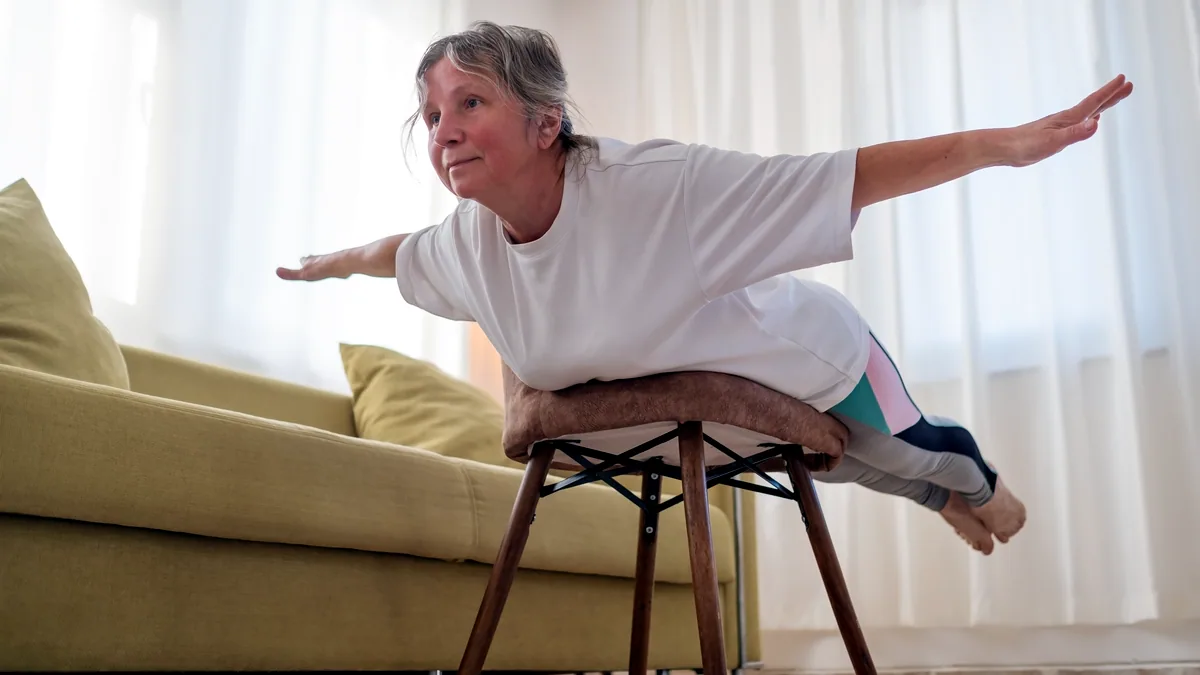
Each move strengthens one muscle that keeps the legs holding the body up, and a full set of all 10 takes 15 to 20 minutes from a comfortable chair. Because they start in the chair, they need no equipment, no balance to get moving, and no prior training, which makes them the first strength routine an 80 or 90 year old can pick up on day 1.
The moves here belong to a wider family of Movement & Exercise for Older Adults, and they pair with the Balance Exercises for Elderly section on this site. The knee-focused moves also overlap with the Knee Exercises for Elderly page, so readers who want a deeper knee routine can continue there after building the base strength described here. This page stays on the legs: the materials, the steps, and the sensory and social purpose of each move.
Materials you need before you begin
The materials for leg exercises for elderly adults are 3 things and a safe room: a sturdy chair, a wall, and your feet in flat shoes. The chair is the workhorse. Use a straight-backed chair with 4 legs and no wheels, and place it so the seat height matches your knee when you stand. The wall gives you a hand-hold for the standing moves, so stand an arm's length away with your fingertips on it. Flat shoes with a firm sole protect your heels and give you grip on the floor, because bare feet on a hard surface can slide during a heel raise.
| Item | What to look for | Why it matters |
|---|---|---|
| Sturdy chair | Straight back, 4 legs, no wheels, seat level with the knee | It is the anchor for all 5 seated moves |
| Wall | Flat, within reach, about an arm's length away | It is the support for every standing move |
| Flat shoes | Firm sole, no heel, grippy bottom | They protect the heel and stop the foot sliding |
No weights are needed for a first routine. If a move later feels easy, a 1 to 2 pound dumbbell can be added to the seated extension, but only after the plain version feels steady, which is usually 2 or 3 weeks in.
How to build the routine step by step
To build the routine step by step, follow the order below: warm up for 2 minutes, do the 5 seated moves, rest 1 minute, do the 5 standing moves, then close with a cool down. This order matters because it moves from the most supported position to the least supported, so the legs are already warm and engaged before they balance on their own.
- Warm up by sitting and swinging each leg forward and back for 30 seconds per side.
- Do the 5 seated moves, 10 repetitions each.
- Rest for 1 minute while seated, feet flat.
- Move to the wall and do the 5 standing moves, 10 repetitions each.
- Cool down with slow ankle circles, 10 each direction.
Do this full sequence 3 times a week on non consecutive days. A 15 to 20 minute session is the target, and a person who completes 3 sessions in a week has done a full strength cycle. Keep a small log of the day and the last move that felt hard, so week 2 can start where week 1 ended.
The 5 seated leg strength moves
The 5 seated moves target the quadriceps, hip flexors, hamstrings, and calves while the chair carries the body weight, so they are safe on a bad day. Perform each for 10 repetitions and pause 1 second at the top of the range.
- Seated march: lift one knee to hip height, lower it slowly, and switch legs.
- Seated knee lift: keep the foot pointed up and raise the knee as high as comfortable.
- Seated leg extension: straighten one leg out in front, hold for 2 seconds, and lower.
- Seated calf raise: sit tall and lift the heels off the floor, holding for 2 seconds.
- Seated knee-to-shoulder: reach one hand toward the opposite knee to add a gentle stretch.
The seated leg extension is the one that most directly feeds into the Knee Exercises for Elderly routine, because it isolates the same quadriceps that bend and straighten the knee. If the extension feels weak on one side, that side is the one the standing squats will need the most help with, so keep the wall close during the next block.
The 5 standing leg strength moves
The 5 standing moves use the wall as a safety net, and they build the balance and ankle strength the seated moves cannot. Keep the fingertips on the wall the whole set, and use it only as a touch, not as a crutch, unless a move feels unsafe.
- Wall-supported squat: slide down to about a 45 degree bend and rise, 10 times.
- Single-leg balance hold: lift one heel and stand for 20 seconds, then switch.
- Forward step: step forward and back, alternating feet, 10 times per side.
- Lateral step: step out to the side and back, alternating feet, 10 times per side.
- Standing heel raise: rise onto the toes and lower slowly, 10 times.
The single-leg balance hold is where the connection to the Balance Exercises for Elderly page is clearest, because it trains the ankle and hip stabilizers that prevent a stumble. A person who holds 20 seconds on each leg has built enough ankle control to try the hold without the wall in a later session, and the standing heel raise adds the calf power that keeps that hold steady.
Sensory and social purpose of the moves
The sensory and social purpose of leg exercises for elderly adults is the part that keeps a person coming back, and it is as real as the strength gain. Each move gives clear physical feedback: the quadriceps burn during the extension, the heels lift on the calf raise, and the balance hold makes the ankle work. That feedback is the reward in a single room, with no audience, and it is the sensory reason a move feels done.
The social purpose grows when the routine is shared. A seated march done with a neighbor in the next chair turns 10 repetitions into 2 minutes of conversation, and a standing heel raise done in a small group gives everyone a visible target to beat by 1 repetition. Because the moves need only a chair and a wall, they fit a kitchen table, a day center, or a park bench, so the group can form anywhere. The strength is the measurable half of the benefit, and the shared feedback is the half that keeps it happening, and both halves together are what a leg exercise routine is for a person who wants to stand a little taller in week 4 than in week 1.