Church Flower Arrangements for the Altar and Nave
Flower Arrangements for Church
A flower arrangement for church is a symmetrical composition of 18 to 24 stems built around a focal bloom, arranged in a 28 cm (11 inch) or 33 cm (13 inch) bud vase and left standing through the 7 days of the weekly liturgy without a single stem change.
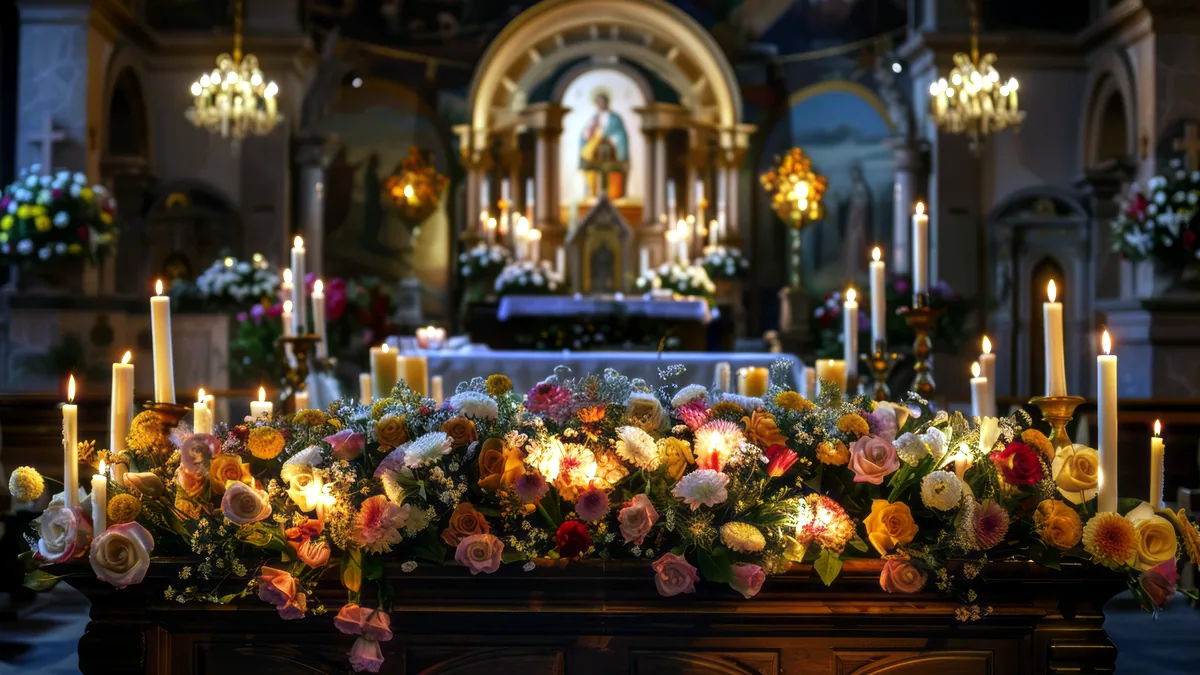
The first arrangement for church on the rota follows the same shape every month, and this is the shape that keeps it alive from the Friday set-up to the Monday clearing.
New rota members rarely need a certificate before they take the first slot; a Flower Arranging for Seniors group or A Flower Arranging Class for Seniors at the parish hall covers the trimming, the grid and the foam in one afternoon. The rota still works for a 24 year old volunteer or a 75 year old flower warden, because the method is fixed and the stems change with the season. Christmas Flower Arrangements are the only monthly build that breaks the symmetrical rule, and they do so on purpose.
What goes on the church altar and the side table
The church altar arrangement is the defining piece because it sits at the focal point of the nave and faces every pew. It is a symmetrical design in a bud vase, and the side table arrangement is the same shape scaled down so the two read as a pair. The table that carries the offering, the communion elements and the service order is where the altar arrangement is balanced against, and a mismatched height on that table is what most volunteers notice first from the back of the nave.
How to build a symmetrical altar arrangement in 6 steps
To build the altar arrangement in a 6 step process, the whole shape is assembled on the work table before it ever touches the altar, and the steps run from the foam down to the final spray.
- Soak a 15 cm (6 inch) block of floral foam for 5 minutes until the surface turns dark, then set it in the bud vase with the top sitting 2 cm (0.8 inch) below the rim.
- Build a cross of 3 long stems, such as a stock, a stephanotis vine and a garden rose, spaced 120 degrees apart to set the frame.
- Insert the focal bloom in the exact centre, a spray of 7 roses or a single large lily, at a height of 20 cm (8 inch).
- Fill the mid zone with 9 to 11 filler stems, such as spray carnation, button mum and anemone, keeping the top line level.
- Add trailing stems to the two lower sides only, so the silhouette stays a rounded dome rather than a flat fan.
- Finish with 5 accent stems of texture, such as waxflower, asparagus fern and a few sprays of dusty miller.
Vase sizes and water management for the week
A 28 cm (11 inch) bud vase holds 1 litre (0.25 gallon) of water and a 33 cm (13 inch) bud vase holds 1.5 litres (0.4 gallon), and both sizes keep a 24 stem arrangement from toppling across the 7 day week. The water level drops about 2 cm (0.8 inch) per day, so the rota entry is a top-up on day 2, day 4 and day 6, and a full rebuild on day 7. A 60 cm (24 inch) square table arrangement uses the same bud vase set into a low bowl, so the height over the table surface stays under 30 cm (12 inch) and the congregation can see over it from the first row of pews.
Seasonal stems that last through the week
The stems that last the full 7 days are the ones that keep drinking, and the table below pairs each month's choice with the vase and the expected life so the rota member can plan the order ahead.
| Month | Seasonal stems | Vase | Expected life |
|---|---|---|---|
| January to February | Spray carnation, stock, anemone | 28 cm bud vase | 6 to 8 days |
| March to May | Tulip, lily, ranunculus | 33 cm bud vase | 5 to 7 days |
| June to August | Peony, delphinium, sweet pea | 33 cm bud vase | 4 to 6 days |
| September to November | Garden rose, chrysanthemum, hydrangea | 28 cm bud vase | 6 to 9 days |
The winter months favour carnation and anemone because they drink steadily and hold colour for a full 8 days, while the summer months lean on peony and delphinium that peak in 3 days and reward a mid-week swap.
When the arrangement marks a life event
The same symmetrical build changes only in its palette when the arrangement marks a life event, because the congregation expects the shape to stay steady and the flowers to carry the meaning. A funeral arrangement for a loss of a loved one uses 25 to 30 white and cream stems, such as white lily, calla lily and cymbidium orchid, set lower than the weekly design so it sits at eye level from the nave. A grand opening or a dedication uses the brightest 12 stem palette of the year, such as a spray of 9 roses in red and a 6 stem burst of chrysanthemum, and it stands for the 3 days of the service plus the 2 days of the open house.
The church altar keeps its weekly rhythm through the year, and the life event builds are the 4 to 5 times it shifts, always returning to the same 28 cm or 33 cm bud vase and the same 7 day water schedule that any rota member can take over on the first Monday of the month.