Fall Flower Arrangements with Harvest Stems
Flower Arrangements for Fall
Flower arrangements for fall are tabletop bouquets built from 3 to 5 warm-toned harvest stems and 2 or 3 textured foliage pieces, cut and placed in a low, wide vessel so the whole composition sits about 20 cm (8 in) tall.
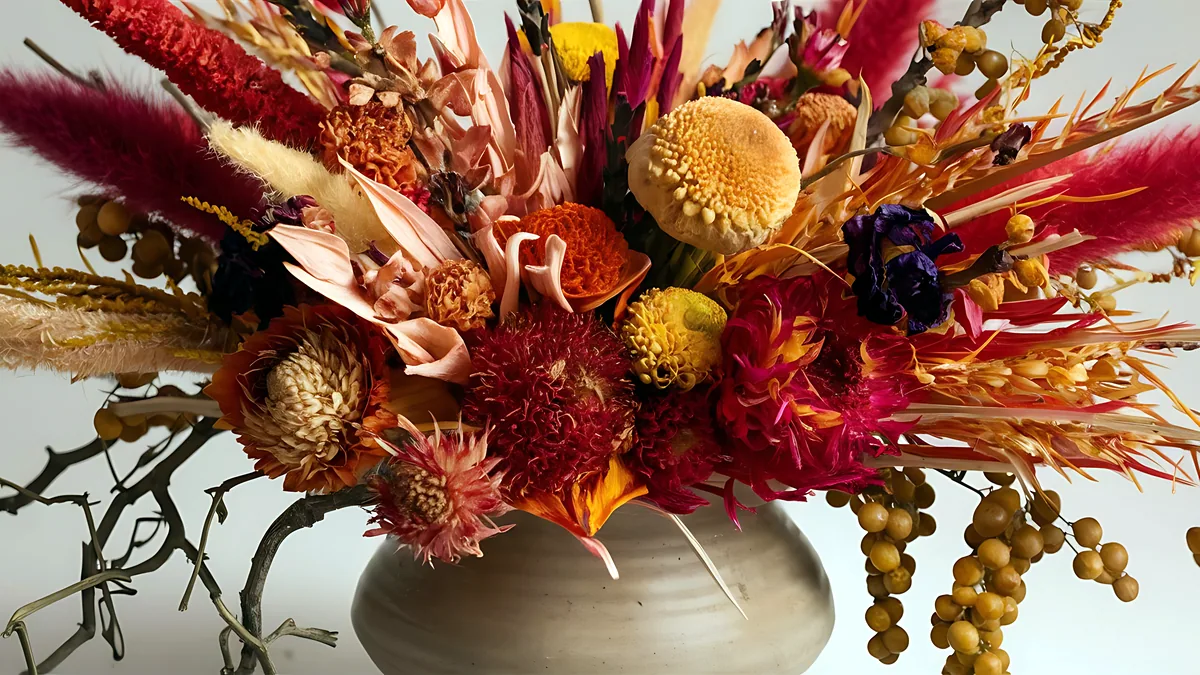
The central stem does the colour work: a marigold, a dahlia or a deep orange rose carries the orange, rust or plum of the season, while a curl of ivy and a sprig of eucalyptus give the shape its brown-green shadow. The finished arrangement should read as a small harvest scene, with a 5 cm (2 in) dome of blooms at one side and a loose trail of foliage across the front edge of the vase.
Stems that carry a fall arrangement
Choose the stems before anything else, because every other step in a fall arrangement serves the colour they carry. A reliable harvest set is 6 blooms, 3 foliage pieces and 1 accent. Blooms that hold their shape well: marigolds, dahlias, chrysanthemums, zinnias, deep red and plum roses, and the flat double heads of cosmos. Foliage that gives the arrangement its shadow: ivy, eucalyptus, brown amaranthus, dried grasses and a single fern frond. One accent, such as a cinnamon stick, a mini pumpkin, or 2 or 3 dried beans, makes the piece read as harvest rather than as a plain bouquet. Marigolds and dahlias are the workhorses: each stem gives a full 4 to 5 cm (2 in) head for 2 or 3 weeks of life in a cool room.
What to gather before you start
Assemble the full kit on the table first, so the build of your fall arrangement never waits on a missing tool. You need: 6 to 8 bloom stems, 3 to 4 foliage stems, 1 accent piece, a low wide vessel (a bowl 15 to 20 cm (6 to 8 in) across, or a jug), floral tape, 2 floral pins, a pair of 18 cm (7 in) shears, and 500 ml (about 2 cups) of lukewarm water. Keep a towel at hand for the trim. If you have 2 or 3 hours of a session, this kit supports a full 12 stem display. If you are leading a group, multiply by 1 per seat.
Step by step, from bare stem to finished piece
Work the stems in this order, and the fall arrangement keeps its shape without wire or heavy support.
- Strip: remove all leaves below the water line on every stem, holding each over the towel.
- Trim: cut each stem at a 45 degree angle with the shears, taking a 2 cm (3/4 in) slice from the base.
- Group: hold the 6 blooms together at the stem tips and measure the dome you want, 10 to 15 cm (4 to 6 in) wide.
- Anchor: cross the 2 strongest stems in an X at the mouth of the vessel and hold them with your hand.
- Build: add the remaining blooms in threes, tightening the X each time, keeping the tallest stem in the back.
- Shadow: tuck the 3 foliage pieces under the blooms, letting ivy trail 8 to 10 cm (3 to 4 in) over the rim.
- Set: place the accent piece in the front left, where the eye lands first.
- Fill: pour 500 ml of lukewarm water to the first node, and step back 1 m (3 ft) to judge the balance.
- Fix: pin or tape any stem that leans more than 15 degrees from the group.
- Seal: check that no leaf touches the water, then move the vessel away from direct sun and heat.
The whole build takes 15 to 25 minutes for one arrangement. The 9 steps above are the same sequence used in Flower Arranging for Seniors sessions, where the strip, trim and group stages are done first so the hands are warmed before the finer pinning work.
A sensory and social purpose
A fall arrangement gives the room a season it does not get on its own, and it gives the maker a task with a visible end. The sensory part comes from the stems themselves: marigolds and chrysanthemums give the strongest scent of any autumn bloom, and the soft brown-green of ivy and eucalyptus sets off that orange without competing for the eye. The social part comes from the format. One person can build a display, but 3 or 4 people building side by side in one room, each with their own kit and one shared table of stems, makes the session. The finished pieces go on the same table, and the comparison of 2 or 3 different takes on the same 6 stems is usually the highlight. A Flower Arranging Class for Seniors runs exactly this way: a short demonstration of the 9 steps, then 45 minutes of hands-on building, then the pieces arranged together for everyone to judge. The structure keeps the task concrete, the pace unhurried, and the outcome something the room can see all day.
Adapting the arrangement for a festival or a wedding
The same harvest stems serve 2 other occasions, and the change is one of scale and symmetry, not of material. For a harvest festival, build 3 to 5 identical small pieces in a low bowl, 12 to 15 cm (5 to 6 in) across, and place them in a row across the table: 1 per 50 cm (20 in) of surface. The repetition is the point, and each piece uses the same 6 to 8 stem kit from the list above. For a fall wedding, build one longer, lower piece, a 40 to 50 cm (16 to 20 in) table runner, with the 6 blooms clustered at one end and the ivy trail carrying the line to the other. Keep the runner under 8 cm (3 in) tall so guests can see each other over it. The wedding piece uses 12 to 15 stems in total, so double the kit and plan for 35 to 45 minutes of build time.
Keeping the arrangement alive on the table
Cut the stems again the same way on day 3 and day 7, and the fall arrangement holds its shape for 14 to 18 days in a cool room. Change the water on each cut, using 500 ml of lukewarm water and a fresh 2 cm (3/4 in) angle trim on every stem. Remove any stem that drops below the water line or turns soft at the base. Keep the vessel out of direct sun and at least 30 cm (12 in) from a radiator, because heat shortens the life of marigolds and dahlias by several days. Dry the accent piece, if it is a dried bean or a cinnamon stick, and leave it in place for the full two weeks; it does not take water and it holds its colour. When the blooms finally soften, the arrangement does not end: strip the ivy and eucalyptus, let them dry upside down for 2 to 3 weeks, and use them as the foliage for the next piece, or as the base for a winter display such as a Christmas Flower Arrangements table setting, where the dried brown-green shadow carries the same warm palette under the deeper reds of the season.